
In the world of logistics, warehousing, and manufacturing, ensuring that your product leaves the line in pristine condition is only half the battle. The real challenge? Making sure it survives the journey to the customer.
Unstable loads, moisture damage, and rough handling during transit cost businesses billions of dollars annually. That is where the unsung hero of the packaging world comes into play: the stretch wrapping machine.
Whether you are a growing business transitioning away from manual hand-wrapping or an industrial operation looking to optimize your automated production lines, this comprehensive guide will break down everything you need to know about stretch wrapping machine technology.
Overview Of A Stretch Wrapping Machine
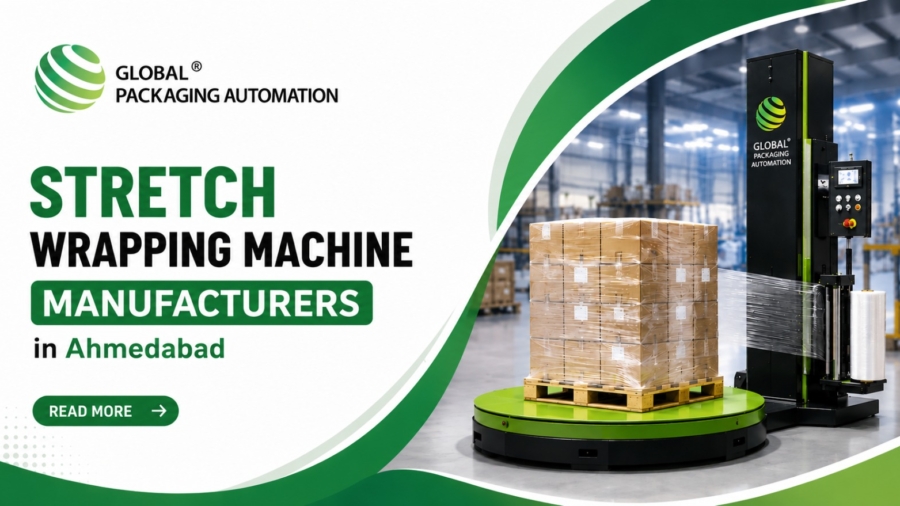
At its core, a stretch wrapping machine (or pallet wrapper) is a piece of equipment used to wrap an LLDPE Elastic plastic film around a loaded pallet. The stretch film is applied under tension, allowing it to contract around the load. This creates a tight, secure unitized bound that prevents shifting, tipping, or damage during transport.
While it sounds simple, the engineering behind modern stretch wrappers is highly sophisticated. They balance speed, film tension, and containment force to ensure optimal packaging with minimal material waste.
Types of Stretch Wrapping Machines
Not all warehouses are built the same, which is why stretch wrappers come in several distinct configurations. Choosing the right one depends on your budget, floor space, and the nature of your products.
1. Turntable Stretch Wrappers: This is the most common and recognizable type of pallet wrapper. The pallet is placed onto a circular turntable via a forklift or pallet jack. As the turntable spins the load, a film carriage moves vertically up and down a mast to apply the film.
- Best for: Standard, stable loads.
- Pros: Cost-effective, compact footprint, highly reliable.
- Cons: Not ideal for extremely heavy, ultra-light, or inherently unstable loads (as the spinning motion could cause them to topple before being fully wrapped).
2. Rotary Arm Stretch Wrappers: With a rotary arm machine, the pallet remains completely stationary on the floor. Instead, an overhead mechanical arm rotates around the pallet to apply the film.
- Best for: Extremely heavy, very light, or highly unstable loads.
- Pros: High speed, handles fragile or top-heavy products safely because the load doesn’t move.
- Cons: Requires a larger footprint and generally has a higher upfront cost than turntable models.
3. Orbital (Horizontal) Wrappers: Unlike turntable or rotary arm machines that wrap vertically, orbital wrappers wrap horizontally. The product travels through a ring that spins stretch film around it.
- Best for: Long, elongated items like pipes, lumber, carpets, doors, or aluminum extrusions.
- Pros: Excellent for non-palletized, long-form manufacturing goods.
4. Mobile Robotic Wrappers: These are battery-powered, autonomous robots that travel to the pallet. After an operator aligns the robot with the load and attaches the film, the robot automatically drives around the pallet until the wrapping cycle is complete.
- Best for: Oversized, oddly shaped loads, or facilities with limited floor space where a fixed machine won’t fit.
- Pros: Ultimate flexibility; you can bring the machine to the product rather than moving the product to the machine.
Advantages
Transitioning from manual hand-wrapping to a stretch wrapping machine is one of the most impactful upgrades a warehouse or manufacturing facility can make. While hand-wrapping might seem manageable at lower volumes, it introduces hidden costs, inefficiencies, and safety risks.
Here is a detailed elaboration of the major advantages of integrating a stretch wrapping machine into your production line:
- Increased Packaging Speed: Manual pallet wrapping is a slow, tedious process. A worker must walk backwards around a pallet multiple times, constantly bending down and reaching up. This process typically takes several minutes per pallet and slows down significantly as the worker tires throughout the shift.
A stretch wrapping machine automates this rotation and film application. What takes a human several minutes can be completed by a machine in under a minute. This dramatic increase in throughput prevents bottlenecks at the end of the production line, allowing you to ship more products in less time.
- Reduced Labor Costs: Hand-wrapping is incredibly labor-intensive. When production volumes grow, businesses often have to hire dedicated personnel just to wrap pallets.
By introducing a semi-automatic or fully automatic stretch wrapper, you significantly reduce the man-hours required for packaging. With a semi-automatic machine, an operator simply drops off the pallet, attaches the film, and presses a button—freeing them up to perform other tasks like labeling or staging the next load. With fully automatic systems, human intervention is eliminated entirely during the wrapping cycle, allowing you to reallocate valuable labor to higher-leverage areas of your operation.
- Improved Product Safety: Wrapping pallets by hand is physically punishing. It requires repetitive bending, reaching, and walking backwards while pulling heavy tension on a film roll. This is a leading cause of musculoskeletal injuries, back strain, and slip-and-fall accidents in the warehouse.
- A stretch wrapping machine removes the physical strain from the equation. Employees no longer have to perform repetitive, awkward movements, which drastically reduces workplace injuries, lowers workers’ compensation claims, and creates a safer, more ergonomic work environment.
- Consistent Packaging Quality: Human beings cannot maintain uniform tension. The first pallet wrapped on a Monday morning will inevitably be wrapped tighter and more securely than the last pallet wrapped on a Friday afternoon. Varied tension leads to inconsistent containment, which risks product damage.
Machines do not experience fatigue. Whether it is the first pallet or the one-thousandth, a stretch wrapper applies the exact same pre-programmed tension, wrap count, and containment force every single time. This uniformity ensures that every load leaving your facility meets strict quality control standards.
- Reduced Material Waste: When wrapping by hand, workers naturally tend to over-wrap “just to be safe,” or under-wrap, which leads to structural failure. Furthermore, humans cannot manually stretch film to its optimal capacity.
Modern stretch wrapping machines feature powered pre-stretch carriages. These systems mechanically stretch the film—often by 200% to 300%—before applying it to the pallet.
- The Math: A 200% pre-stretch rate turns 1 meter of film on the roll into 3 meters of usable film on your pallet.
This drastically reduces the amount of plastic used per load, slashes your annual film expenditures, and minimizes your business’s environmental plastic waste.
- Better Load Stability: The ultimate goal of pallet wrapping is unitization—making sure the individual boxes and the wooden pallet move as a single, rigid unit. If a load is wrapped too loosely, the items will shift, slide, or collapse during transit when the delivery truck brakes or turns.
Stretch wrapping machines excel at creating high containment force (the compression force holding the load together). They can also be programmed to deliver extra wrap cycles at the bottom of the pallet to firmly lock the load to the wooden structure. This structural integrity ensures the pallet can withstand the vibrations and chaotic movements of long-haul transportation.
- Dust and Moisture Protection: During storage and transit, goods are exposed to various environmental hazards, including dust, dirt, rain, and humidity. If items sit in a dusty warehouse or are loaded onto an open flatbed truck, elements can easily ruin the product packaging.
A machine provides a tight, overlapping, continuous layer of film that acts as a protective shield. Because the machine applies film with precise overlaps, it creates a much tighter seal than hand-wrapping can manage. This keeps your products clean, dry, and free from environmental contamination from the moment they leave your dock to the moment they arrive at the customer’s door.
- Professional Appearance: First impressions matter in business. When your clients receive a pallet that is neatly, tightly, and uniformly wrapped by a machine, it signals professionalism and strict quality standards.
Conversely, a hand-wrapped pallet often looks sloppy, with uneven film layers, dangling tails of plastic, and crushed box corners from improper tension. A neat, machine-wrapped pallet not only reflects well on your brand image, but it also makes the load much easier and safer for your customers to unpack and handle upon arrival.
Conclusion: Wrapping It All Up
In modern supply chain management, efficiency is the difference between a thriving business and a struggling one. Relying on manual labor to secure your pallets is slow, expensive, and unsafe.
By upgrading to a stretch wrapping machine, you protect your products, slash your film expenses, keep your workers safe, and ensure that every single pallet leaves your dock looking professional and secure. It’s not just a purchase; it’s an investment in your company’s scalable future.
Global Packaging Automation is a leading manufacturer and trusted supplier of the PR 2000BW Pallet Stretch Wrapping Machine in Ahmedabad. Serving businesses of all scales across diverse industries, we are committed to engineering high-quality, durable equipment designed for reliable, long-term performance.
Our commitment to your success goes beyond the sale. We provide comprehensive after-sales support—including professional installation, operator training, and ongoing maintenance—to ensure your operations run smoothly and efficiently. From standard models to highly customizable strapping and wrapping solutions, we tailor our equipment to match your exact packaging requirements.
Ready to upgrade your packaging line? Click here to explore our wide range of products, or watch our latest machine demonstrations on our YouTube channel, Global Packaging Automation LLP.
Get a quote today by replying to this email at info@globalpackindia.com or calling us directly at +91 7738819711.